Tuesday, April 13, 2010
Carnival of Homeschooling
I participated in a Carnival of Homeschooling this week. You can find my entries as well as many other homeschooling topics at Our Curious Home.


Monday, April 12, 2010
Who Am I? – All About Reading Book 2

All About Learning, producer of All About Spelling, is getting ready to introduce the second reader in their All About Reading series. It is called Who Am I? The stories are about 10 pages long with much more reading on each page than in All About Reading Book 1 which I reviewed here. Who Am I? follows the same sequence as All About Spelling Level 2.
There is definitely a variety of stories in this book. The story about the snakes getting loose in the pet shop was kind of creepy, but I bet a boy would love it. Then there are stories about robots, skunks, horses, and more. There is even a chapter with poems.
I found the words to be on a good level but some such as “emit” and “silt pond” were unfamiliar in use to my kindergartner. But it makes a great opportunity for a vocabulary lesson even at this early age.

This book is a perfect fit for my 6-year old daughter who is reading at about a 2nd grade level. And she likes the stories.

You can read here what other Crew members experienced and be watching for the unveiling of this new reader.
Disclosure:This product was provided to our family for free as members of the 2009-2010 Old Schoolhouse Magazine Homeschool Crew. No further compensation was received. Reviews and opinions expressed in this blog are my own.
Friday, April 9, 2010
The Terrestria Chronicles
Keeping our children supplied with good books can be quite a challenge when they love to read. So we are always looking for new authors who interest them.
 The Terrestria Chronicles written by Ed Dunlop and published by Cross and Crown Publishing is one such series we reviewed. Targeted for ages 10 and up, the start of this allegorical series has proven to be interesting reading for my 13 and 14-year old daughters. Portrayed in a medieval-like setting, The Sword, The Ring, and The Parchment (Book 1) and The Quest for Seven Castles (Book 2) provided much enjoyment as well as food for thought as Josiah, the main character, is freed from sin and made a prince by King Emmanuel. He goes through his new life and must make decisions for good or evil at every turn. Amid the knights, ladies and castles, there are representations of the armor of God, the Bible, prayer and the other Biblical disciplines throughout the series. Each castle in the kingdom represents different virtues, such as Temperance and Knowledge. Characters with names like Encouragement and his twin Discouragement, as well as Doubting and his brother the Gia
 nt of Fear are prevalent throughout the books. The stewards of the castles have names like Sir Faithful and Sir Honorable. In these books, Josiah learns important lessons like the dangers of the “Little Sins” of Envy, Greed, Discontentment, etc. as well as the need of prayer and faith. Although an allegory of the Christian life, these books have a different feel than stories such as Pilgrim’s Progress.
There are 7 books in The Terrestria Chronicles which can be purchased individually for $7.99 or as a set for $39.99. You can also order this set of 7 in hardback for $73.99. If you want to use this series for deeper study you can purchase Visits to Terrestria, A Study Guide for Parents, Teachers and Students. (There is a free answer key online.) If you find that you like this series, Ed has written another series called Tales from Terrestria.
My girls definitely liked the first 2 books in the series and would like to read more. Read here to see what other Crew families thought.
If you want to get a taste of Ed Dunlap’s writing, you can download his free Jed Cartwright Adventure Series.
Disclosure:This product was provided to our family for free as members of the 2009-2010 Old Schoolhouse Magazine Homeschool Crew. No further compensation was received. Reviews and opinions expressed in this blog are my own.
Wednesday, March 31, 2010
Family Mint

One skill that we want to ensure our children possess as they become adults is good money management. Family Mint is one way that we can do that. It is a money management program for kids where the parents are the banker.
Each child has his own account which can be accessed anywhere there in an Internet connection. He can enter transactions such as deposits and withdrawals. He can also set and track financial goals. Parents can motivate their children through paying interest and matching fund contributions. They can even automate allowance. The parent also has the ability to approve or disapprove transactions. This feature can be disabled, if desired.
The website is straight-forward. In the parent interface you have access to all your children’s accounts. For the child interface you can choose between Junior and Advanced depending on the skill level of your child.
What I have described above is for the Free Edition. A Pro Edition is in the works which will include more features but will be charged a fee.
The thing I like about Family Mint is that each child has access to his account. He can learn to manage his money, but the parent still has oversight of the transactions. You can read here what other Crew Members experienced.
Disclosure:This product was provided to our family for free as members of the 2009-2010 Old Schoolhouse Magazine Homeschool Crew. No further compensation was received. Reviews and opinions expressed in this blog are my own.
Monday, March 29, 2010
Math Galaxy
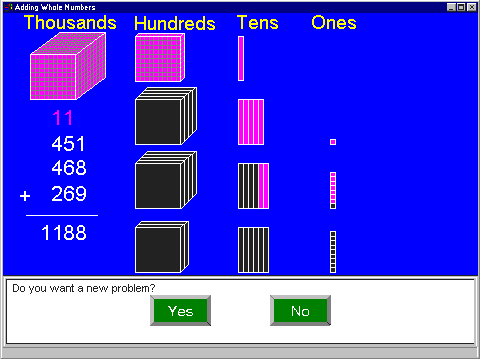
 Galaxy of Education is a company that sells a variety of math games. Their Math Galaxy series goes all the way from addition to algebra. One of the first things I noticed about the Math Galaxy Fun programs is that there is always a visual as well as abstract element included. After a problem is answered, the problem is visually worked out, including the combining or borrowing tens, hundreds, etc.
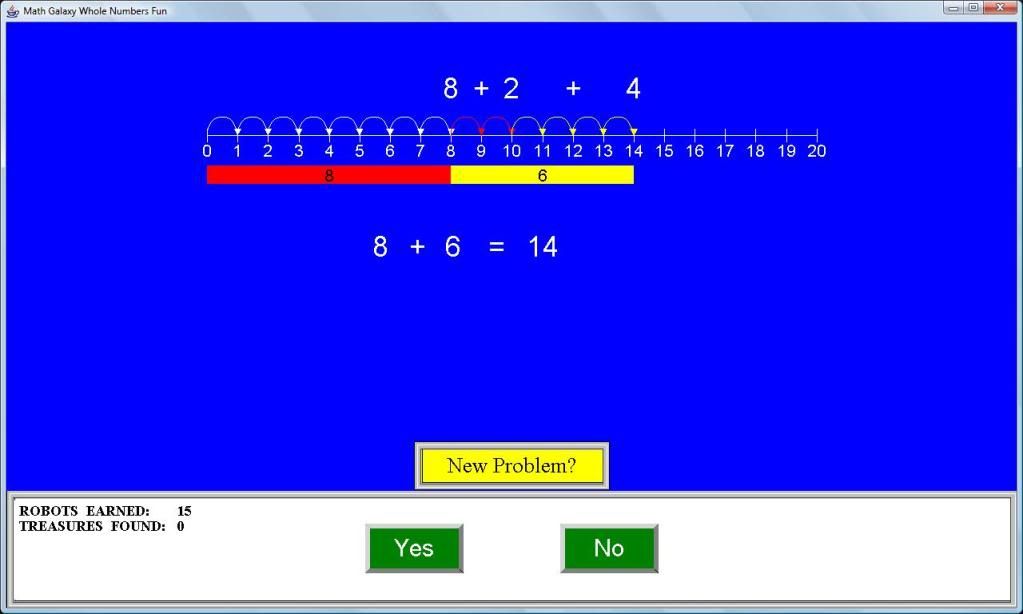
A further strong point to me is that in the Addition Tables and Addition on Number Line screens, numbers are grouped to ten first then added further from there. Example: 6+8 = 6+4+4 = 14.
A third feature that grabbed my attention is that in the subtraction module, the corresponding addition equation is shown after the answer has been entered. Also, in the division module, the corresponding multiplication equation is shown.
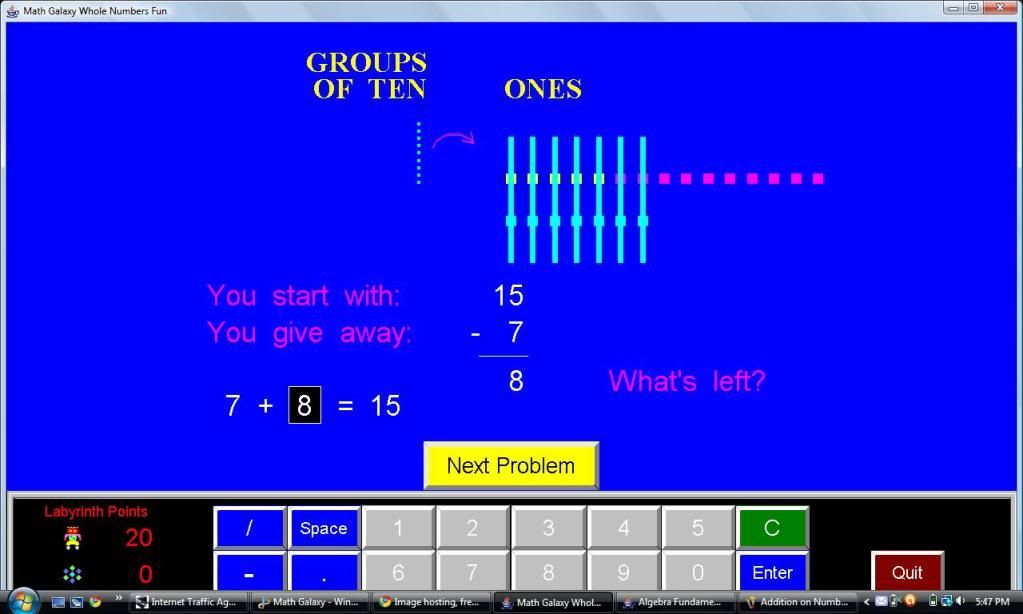
These programs provide two different modes to work in. In the Step-by-Step Mode, the player is prompted through each step of the problem. This can be very helpful for someone just learning how to do a particular math process. The Total Answer Only Mode just prompts for the answer. Both modes visually work out the problem.
Math Galaxy is available for Whole Numbers, Fractions, Decimals, Word Problems, Pre-Algebra, and Algebra. They are $29.95 each.
There are also games included with the tutorial programs. All the games have a choice of different operations and subtopics.
In Word Jumbles, you match math problem answers to letters to spell the word. 1, 2 or 3-player options are available. “Money” is earned for each letter/word guessed. It is a bit cumbersome to use as several mouse clicks are required for each move.
Riddles is the same as Word Jumbles except you are solving a riddle.
With Bridge the Swamp, you work your way across the swamp by matching numbers to reach totals. However, the instructions are a little unclear and I haven’t totally figured out how to play it yet. You can compete one player against the computer or use two-player mode.
In Labyrinth, you use robots you have earned while working through other math problems.
Math Riddler Worksheet Generators
Math Riddler Worksheet Generator programs are also available from Galaxy of Learning. With these you also have the choice of different operations including Whole Numbers, Fractions, Decimals, Proportions, Percents, and Algebra. They are $29.95 each.
Riddle Mode provides a printable worksheet with a riddle for the student to solve through answering the math problems. Worksheet Mode provides a randomly generated worksheet with straight math problems. You can print these worksheets with either answers or no answers.
SUMMARY
These games don’t flow like top of the line programming; however, the information provided and the skills practiced make it worth using.
The Math Galaxy games are too hard for my Kindergartner and will be a better fit once she learns higher addition and subtraction. My 9th grade daughter really likes the Algebra labyrinth game and finds herself spending much longer on it than she usually spends on online math games.
You can see more detail on these products at the Galaxy of Education website. Also, please read the reviews of my other Crew Mates.
Disclosure:This product was provided to our family for free as members of the 2009-2010 Old Schoolhouse Magazine Homeschool Crew. No further compensation was received. Reviews and opinions expressed in this blog are my own.
UPDATE 4/2/2010
I mentioned in my review that Math Galaxy was too hard for my kindergartner. What I didn’t consider was having her use the manipulatives from her math program. So today I had her try the Whole Numbers Fun 1-digit addition. She worked the problem using her cuisennaire rods and then entered the answer. Math Galaxy then confirmed with its visual display what she had found with her rods. So she got the visual reinforcement from two ends. It worked great!
Wednesday, March 24, 2010
Seasons of Faith Series
“To everything there is a season, a time for every purpose under heaven.”
The Seasons of Faith illustrated book series from Children’s Bible Hour was written to help children through the different seasons of life. Each story also lays out the plan of salvation.
Spring is a time when people experience new life in Christ. Faith develops and Christians begin to share the Salvation message with others.
Summer is the season when faith grows under God’s love and care. Fruit is witnessed and triumphs are gained through applying His Word and striving to be the best we can be in Christ.
Autumn can be times of struggle and temptation, peer pressure, making mistakes, and scary transitions. Even though it might seem like nothing good can come from this time, God has promised us He will be there. He will teach us how to forgive and then grow in grace.
Winter is the most difficult. Deep struggles, mourning, trying to make it through difficult times, or the death of a loved one can pull us away from God. He teaches us to lean on Him for comfort and peace.
The stories, adapted from radio scripts of the Children’s Bible Hour, encourage children in their faith. These soft cover books are nicely done and have many illustrations. The included audio CDs provide page prompts so it is easy for your non-readers to follow through pictures while listening to the stories read by “Uncle Charlie”. The CDs brought back memories of hearing “Uncle Charlie” on the radio when I was young. There are currently four books in the series. You can find discussion questions on the CBH website if you want to discuss the stories further with your child but don’t know where to start.

Race with Midnight (Spring) is about a girl who wants to share her faith in God with her family but doesn’t know how she will do that. She prays for the opportunity to do so, and God opens the door for her to share what He has done in her life.
You Can’t Come In (Summer) provides a word picture of how sin keeps us out of heaven and clearly shows our need for salvation through faith in Christ.
Seventy Times Seven (Fall) is about our need to forgive so that we can be forgiven.
Braving the Storm (Winter) is about a boy whose family is going through a really rough time. He doesn’t understand why God would allow it to happen. Watching the trees during an ice storm helps him to understand that he needs to grow his roots of faith deep so that he can survive any storm of life that comes.
My 14-year old, 13-year old, and 6-year old daughters all really enjoyed these books. Seventy Times Seven is the favorite for my 14-year old. You Can’t Come In is the favorite for my 13-year old. Race With Midnight is my 6-year old’s favorite. My favorite is Braving the Storm although I like the others too. So as you can see the series appealed differently to each of us.
Each book in this series costs $10 which includes a 10”x5.5” book and an audio CD. You can read here what other families had to say.
Disclosure:This product was provided to our family for free as members of the 2009-2010 Old Schoolhouse Magazine Homeschool Crew. No further compensation was received. Reviews and opinions expressed in this blog are my own.
Monday, March 22, 2010
History Odyssey Middle Ages Level 2 and 3
History Odyssey from Pandia Press is a literature-based study guide combining history, geography, and writing. It includes intensive writing opportunities but is not a writing course. This review will be for Middle Ages Levels 2 and 3. To give you an idea of what types of subject areas your student would be learning in both levels, here is a list of what sections are to be included in his binder.
- Summaries
- Men & Women
- Wars & Conflicts
- Religion & Mythology
- Arts, Inventions, & Architecture
- Maps & Worksheets
- Timeline
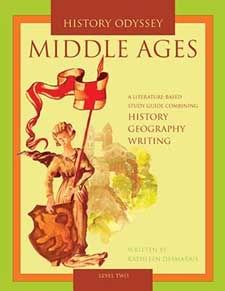
LEVEL 2 OVERVIEW
The main tools used for learning in History Odyssey Level 2 are outlining, summaries, timelines, mapwork (outline maps included), and research. Literature reading is also included followed by some type of writing assignment or worksheet. Several biography reports as well as compare/contrast assignments are completed during the year. (Instructions for writing a biography are included in the appendix.) One fun project completed during the year is that the students make a Shakespeare book including pages they have colored (from A Shakespeare Coloring Book) and their rewritten versions of Shakespeare’s works. Another project that is completed during the year is the construction of a castle. Worksheets are use sparingly but effectively throughout the program. Many times in Level 2, the main outline points are given which help students learn to find the main and then subpoints of a passage. You can also adapt how detailed an outline or summary you require based upon your student’s skill level. A timeline analysis is completed at the end of the guide. The final writing project is the most complex writing assignment and consists of a multi-paragraph, persuasive paper.
One of the scheduled books, Viking World, has gone out of print so optional internet links are included for the assignments.
You can learn more about History Odyssey Level 2 by looking at the Table of Contents, Book list, and Level 2 Sample.
LEVEL 3 OVERVIEW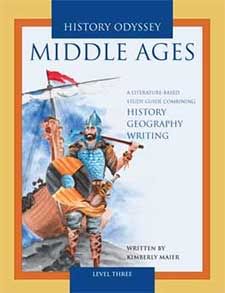
The main tools for learning in History Odyssey Middle Ages Level 3 are outlining, people research (Who’s Who Gallery), mapwork, timelines, literature analysis, essays, and research projects. As in level 2, worksheets are judiciously used. Research projects may be about a specific history topic, art, culture, travels, or other areas. Examples of other projects include making an informative brochure and preparing a 3-day lesson plan for teaching culture. The lesson plan must include Performance objectives, Materials list, Procedures, Discussion questions, and Evaluation.
One lesson does not necessarily equal one day of work. There are some really involved projects in this level.
Included in the appendix are instructions on how to write a thesis statement, an essay grading rubric, and blank maps.
You can learn more about History Odyssey Middle Ages Level 3 by looking at the Course Outline, Book list, and Level 3 sample.
COMPARISON OF LEVEL 2 AND LEVEL 3
On the surface History Odyssey Levels 2 and 3 look very similar. However, level 2 is like the tip of the iceberg to level 3. While level 2 uses outlines, summaries, and biography reports, Level 3 builds on those skills requiring the student to dig deeper. The Level 3 outlines require much more detail and the research assignments are more involved. Instead of an emphasis on biography reports, Level 3 assigns several essays. The books used in level 2 are easier reading while the books in level 3 are more original works. Level 3 also requires deeper literature analysis. Both levels make judicious use of worksheets to solidify the topics being taught.
You can expect to spend 2 hours three to four times per week to complete this program in a year.
PROS
- Literature-based but not a lot of resource investment
- Minimal teacher preparation
- Clear instruction written directly to student
- Blank outline maps included
- Clean layout and presentation
- Meaty
CONS
- Might be more writing intensive than some want
- Levels 2 and 3 do not correspond
FINAL WORD
I think that History Odyssey is very well done. Its clean layout and rich content make it a great choice especially for those who want a literature-based program but need the ease of self-directed material. You can purchase an e-book edition for $33.99 directly from the Pandia Press website. A print copy can be purchase from various vendors and has a suggested retail price of $38.00. It is non-consumable.
Pandia Press also carries a product called R.E.A.L.Science Odyssey.
You can read here what other Crew members discovered with their Pandia Press products.
Disclosure:This product was provided to our family for free as members of the 2009-2010 Old Schoolhouse Magazine Homeschool Crew. No further compensation was received. Reviews and opinions expressed in this blog are my own.
Subscribe to:
Posts (Atom)